
Premium
Ancient Bodrum Walk
A guided route focused on Bodrum’s ancient remains and cultural identity.
From €Book now
Destination guide
Mugla / Marmaris
Amos Ancient City is one of the most important historical settlements of the Bozburun Peninsula, offering breathtaking views over Kumlubük Bay and a unique ancient theatre overlooking the sea.
Featured selection
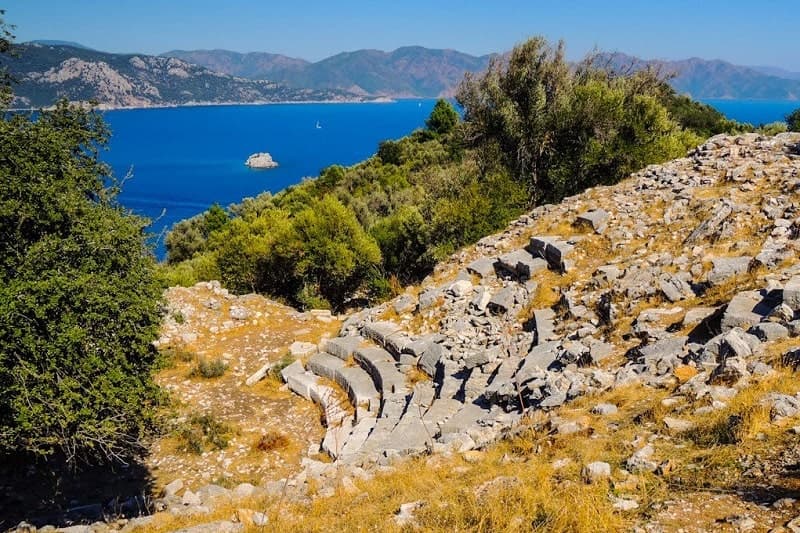
Located near Turunç in Marmaris, Amos Ancient City stands on Asarcık Hill, overlooking both Kumlubük and Asarcık bays. With its strategic coastal position and impressive ruins, Amos offers a perfect combination of history, nature, and panoramic sea views. Built as a fortified hill settlement rising on terraces, Amos reflects the classical structure of ancient Carian cities and is considered one of the most significant archaeological sites in the region.
Amos was one of the leading cities of the Bozburun Peninsula, known in antiquity as the Carian Chersonesos. The city was established on Asarcık Hill, a strategic location extending towards the sea, naturally protected by two harbors on both its northern and southern sides. Archaeological evidence suggests that settlement in Amos dates back to the Early Iron Age, with continuous habitation beginning around the 10th century BC. By the 5th century BC, Amos appears in historical records as a member of the Delian League, indicating its integration into the wider Aegean political and economic network. During the 4th century BC, the city came under the control of Rhodes and became part of the Rhodian Peraea. This period marked significant development for Amos, both economically and culturally, as it played a role in regional trade and agriculture. The city reached its architectural peak during the Hellenistic period, when its main structures such as city walls, towers, temples, residential buildings, and the theatre were constructed. Unlike many other settlements in the region, Amos retained its original Hellenistic character without major Roman modifications. However, in the 3rd century AD, a series of earthquakes led to the gradual abandonment of the city, after which it was never reoccupied.
The urban layout of Amos reflects a terraced hill settlement surrounded by defensive walls. The acropolis at the top of the hill likely housed a temple dedicated to Athena, while a lower terrace contained another temple dedicated to Apollo Samnaios. One of the most remarkable structures in Amos is its ancient theatre, built between the late 3rd and early 2nd century BC. With a capacity of approximately 1000 people, it is the only known theatre among the ancient cities of the Bozburun Peninsula that was part of a civic settlement rather than a sanctuary. Originally designed as a single-story structure, the theatre’s stage building was later expanded into a two-story construction during the Hellenistic period. Unlike many ancient theatres, it remained largely unchanged during the Roman era and continued to be used until the 3rd century AD. Based on the size of the theatre and residential structures, it is estimated that the population of Amos reached around 3000 inhabitants. Ancient sources suggest that Amos had a highly productive agricultural system, particularly known for its olive groves and vineyards. The fertile land around the city allowed inhabitants to produce and lease agricultural land, forming an important part of the local economy. The Athenian statesman Aeschines, who lived in exile in Rhodes, is known to have owned property in Amos and described its rich agricultural landscape. The modern discovery of Amos dates back to the 19th century. Early explorers identified the ruins on Asarcık Hill, and later studies confirmed the site as ancient Amos. The first excavations were conducted in 1948, revealing inscriptions related to land lease agreements, providing insight into the economic life of the city. After a long period without research, systematic archaeological studies resumed in 2019 under the direction of Turkish archaeologists. Excavations continue today with official support, contributing significantly to our understanding of the site. • One of the most scenic ancient theatres in Turkey • Unique hilltop city overlooking two bays • Rich Carian and Hellenistic history • Peaceful and uncrowded archaeological site • Perfect combination of nature and history
Visitors can explore the remains of the theatre, city walls, temples, and residential structures while enjoying panoramic views over Kumlubük Bay. The site offers a quiet and immersive historical experience surrounded by nature.
This place is ideal for history lovers, culture-focused travelers, photographers, and visitors who want to go beyond the standard beach holiday experience in Bodrum.
• History and archaeology enthusiasts • Nature lovers • Photographers • Travelers looking for hidden gems
Amos Ancient City is located near Turunç and can be reached by car. A short hike is required to reach the hilltop ruins.